


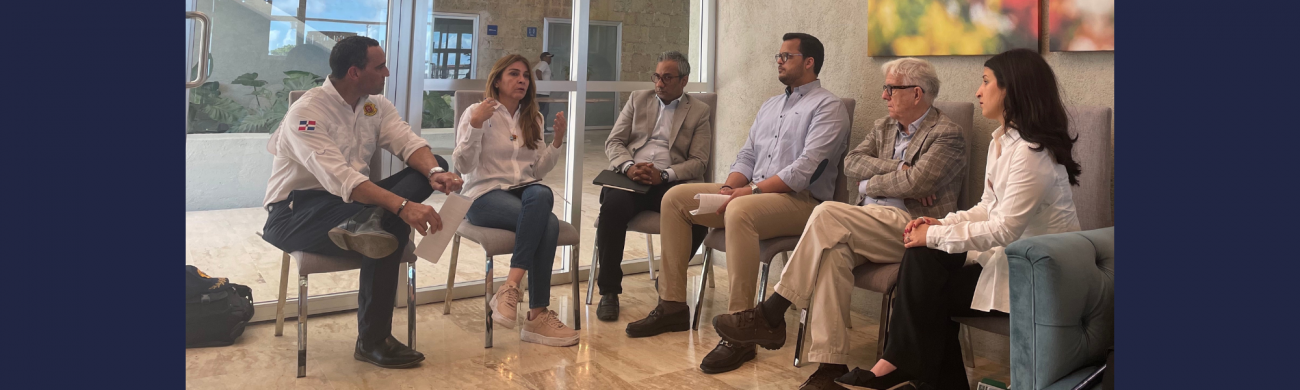
Last month, the Columbia World Project (CWP) Building Climate-Resilient Communities in the Dominican Republic team convened in the Dominican Republic to meet with Mayor Carolina Mejia, her team and other key stakeholders. The mayor affirmed her commitment to making the resilience center a reality, and emphasized the importance of the resilience center as a model for the country and region on how to strengthen community-based resilience to natural disasters and other crises.
The visit took place after a cumulation of a series of activities that informed the recommendations and implementation plan for the resilience center. Over the course of eight weeks, team members from the Universidad Iberoamericana (UNIBE) led workshops to gather information, map resources, and engage the community in designing social infrastructure recommendations. Among the community members engaged were student architects to collect and upload physical attributes of the community (e.g. housing, pathways, community centers, drains and electric lines, etc.), conduct interviews with residents, and propose recommendations for the resilience center that directly respond to community needs and bolster climate resilience. The assessments are now complete and the project team is analyzing and preparing the results to inform a forthcoming resilience center blueprint.
The project, launched last November to develop a guide, or blueprint, to strengthen the country's ability to resist natural disasters and adapt to climate change is focusing on plans for a resilience center in the community of Cristo Rey in Santo Domingo. The blueprint will also include information for center replication across the country and region. The multidisciplinary team from Columbia University, UNIBE, the Instituto Tecnológico de Santo Domingo (INTEC), and the Mayor’s Office of Santo Domingo (ADN) are working together to assess the existing physical, digital, energy, social, health and policy infrastructure in the community to better strengthen these elements essential to disaster risk reduction.