


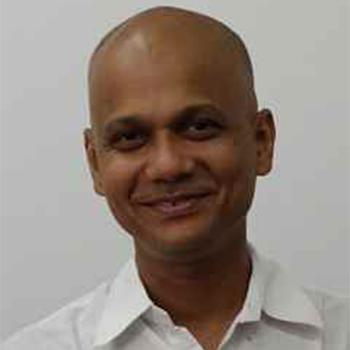
Anreerudha Paul
Aneerudha Paul is an architect, urban designer, and educator with extensive experience in architectural and urban research, practice, and policy engagement. He completed his B.Arch from Bengal Engineering College, Calcutta (now the Indian Institute of Engineering Science and Technology, Shibpur) in 1990, followed by an M.Arch from the School of Planning and Architecture, New Delhi, in 1993. He further specialized in urban management with a postgraduate diploma from the Institute of Housing Studies, Rotterdam. He has completed doctoral studies at the Indian Institute of Technology, Bombay (IITB), under the Center for Urban Science and Engineering (CUSE), researching on “Exploring morphologies of compact and complex informal settlements in Indian Cities : Case Study, Mumbai”.
Paul has been a pivotal figure at the Kamala Raheja Vidyanidhi Institute of Architecture (KRVIA), Mumbai, serving as its Director from 2004 to 2021 and continuing as a professor. Through KRVIA’s Design Cell, he has led research initiatives engaging government agencies, community organizations, and stakeholders to develop alternative, sustainable urban futures.
In 2021, he co-founded CODES LLP, a collaborative design practice focusing on architecture and urban design. He also serves as a technical consultant to SPARC, actively working on projects addressing the needs of urban and rural marginalized communities. Currently, through SPARC, he is directing "Closing the Loop – Planning Nature-Based Decentralized Wastewater Systems for Villages in the Peri-Urban Mumbai Metropolitan Region," a climate change mitigation project funded by the United Nations Development Programme (UNDP) and The Adaptation Fund Climate Innovation Accelerator (AFCIA) funds. He is also the Principal Investigator of the ‘Bottom-up Approach to Improving Informal and Shared Mobility- based Livelihoods and Infrastructure in the Peripheries of the Mumbai Metropolitan Region’ which is a part of Partnership for Research on Informal and Shared Mobility, funded by Volvo Research Education Foundation in collaboration with Columbia Climate School.
His contributions extend beyond academia and practice; he has presented research at numerous national and international conferences, published extensively on urbanism and architecture, and participated in key government advisory committees shaping policies on critical architectural and urban projects. In July 2007, he was selected for the International Visitors Leadership Programme on Cultural Heritage Preservation, organized by the U.S. Department of State, further strengthening his expertise in heritage and urban conservation.