


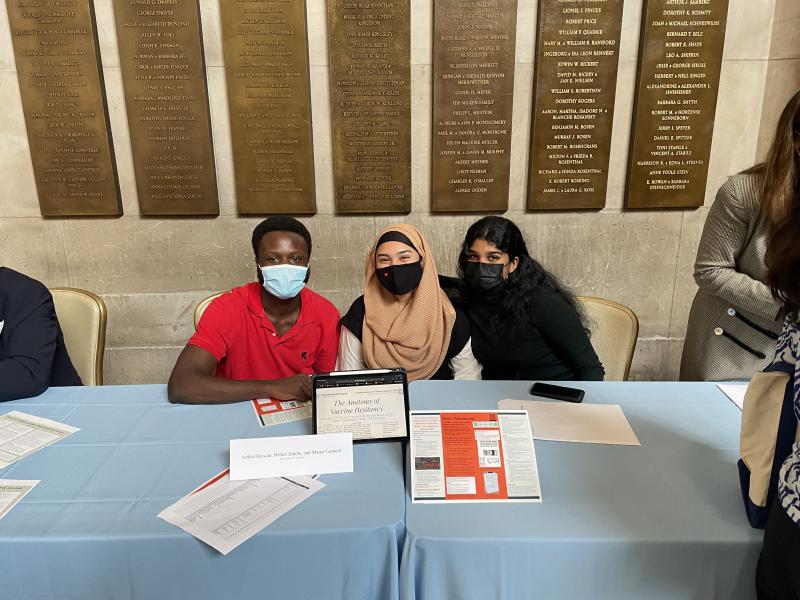
 Student researchers on the Increasing COVID-19 Vaccine Confidence project won first place in Humanities and the Arts at the Columbia University Undergraduate Research Symposium.
The Columbia World Project Increasing COVID-19 Vaccine Confidence aims to increase public confidence in the COVID-19 vaccine.
The project is using artificial intelligence tools to assess the ways in which people express vaccine hesitancy online and then mobilizing that data to develop public health messaging that combats vaccine hesitancy. This past summer, four students supported the project leads, professors Rishi Goyal and Dennis Tenen, in their project research.
In an interview, the students explained how artificial intelligence helped them better understand vaccine skepticism in Native American, Black American, and Muslim communities. For their work on the project, Bethel Ikenna Adiele, Mansi Garneni and Adiba Hussain won first place in the Humanities and the Arts category at the Columbia University Undergraduate Research Symposium. These quotations have been edited and condensed.
Bethel Ikenna Adiele
Junior, Columbia College
I’m studying Medical Humanities and did a research project last year on how COVID was disparately affecting communities of color. My focus for this project has been on the Black community in the United States. Something I found a lot when I went through YouTube and Black Twitter was mentions of systemic racism. I saw a lot on cases like the Tuskegee syphilis experiments [in which the United States Public Health Service studied syphilis in a group of Black men without their consent, and withheld treatment to men known to have the infection.] You see a lot of mention of those historical instances of medical abuse. And that trickles into anti-vaccination language. People are afraid that the government is trying to kill them or cause genocide in the Black community. But I also found a lot of promising instances where people understand the need to be vaccinated.
Another thing I saw is that the there’s a major problem of access within the Black community. There’s hasn’t been proper access to vaccination historically, or, in fact, to any other form of health care. And so people wonder why they’re being pushed to get vaccinated now, when in the past they’ve had trouble accessing other forms of health care. Increasing access to proper medical interventions is necessary to repairing that bridge.
Mansi Garneni
Junior, Columbia College
I’m pre-med and an English major. My interest in medicine is primarily in going into native health care, focusing on issues such as addiction. This project intersects with all three of my interests, health care, computer science and English.
I’m focusing on the Native American community. What I found by going through social media was that there’s a really deep-rooted mistrust in a lot of Native American communities of the federal government, and a lot of people draw on past examples of medical abuse as a reason for their vaccine hesitancy. There is also the historical example of the first mass vaccination campaign, the smallpox vaccine, where the U.S. government used it as leverage to take people off their lands and move them onto reservations.
Our data shows us that there are specific examples that keep showing up in anti-vaccination discourse in this community. And with that data, public health departments can make their messages more personalized and targeted to counteract hesitancy.
Adiba Hussain
Junior, Barnard College
I took a class in Computer Science at Columbia and was introduced by professor Dennis Tenen to the intersection between computer science and English, which I didn’t really know about before.
I’m researching vaccine hesitancy in the Muslim community. I am Bengali Muslim myself. Being able to understand the nuances of how COVID is affecting the Muslim community is very interesting to me, and so I decided to do that in a more technical way.
One of my initial findings is that some people don’t want to take the vaccine because of their faith in God. They believe God will save them, so they don’t need to be vaccinated. Another theme is skepticism about the ingredients in the vaccine, and fears that it might contain pork, which Muslims are not allowed to eat.
With the Artificial Intelligence tools that we've been learning, we've been able to see specific patterns throughout large pieces of text that would have otherwise taken a really, really long time to identify.
Sharla Kirkpatrick
Sophomore, North Carolina Agricultural and Technical State University (Part of the Summer Research Early Identification Program through the Leadership Alliance, Columbia University Graduate School of Arts and Science)
For this project, I’ve been looking at vaccine hesitancy in the Black community. I’ve been looking at four main things that affect vaccine uptake: Historical context, like the Tuskegee experiment; modern healthcare disparities, like equity in where vaccines are distributed; psychology; and then social media.
The sheer amount of influence that social media has over people has been really surprising to see. People have found themselves trapped in a misinformation cycle that they couldn’t escape.
One thing that is important is going out and finding stories of those who were mistreated by the medical system, like the family members of those who were forced to participate in the Tuskegee study, and sharing their stories of vaccination. Hearing stories about successful vaccinations is really important for people to feel comfortable following in their footsteps.