


By: Sophie Holin, Isabel Hou, and Mariana Valle
Artificial Intelligence systems are simultaneously dependent on quality journalism and destructive to journalism’s sustainability and viability. To understand what that means and what to do about it, the fifth edition of the Saving Journalism Conference brought together over 100 researchers, policymakers, publishers, and funders from across the globe.
Titled "What Can We Learn from the Rest of the World?," this year's conference examined new research on media economics, ownership, incentive structures, AI’s effect on the media landscape, the state of U.S. journalism one year into the Trump administration, and new frontiers in media policymaking.
The event was hosted by Columbia SIPA's Technology Policy and Innovation Concentration, McGill University's Centre for Media, Technology and Democracy, the Columbia Global Paris Center, and Columbia World Projects, on March 19 and 20, 2026, at Global Center Paris’ Reid Hall. It was made possible with support from the Alliance Program.
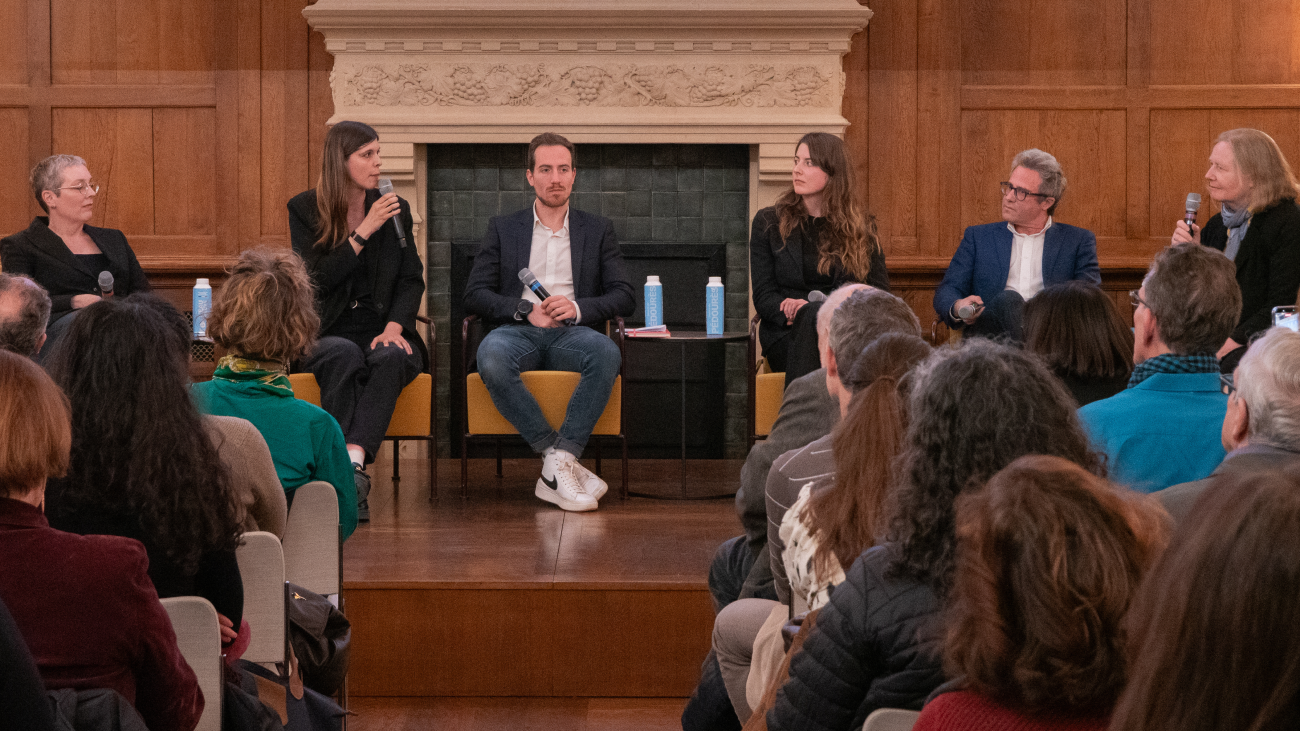
The conference kicked off with a public panel on “Online Influencers, Politics, and Free Speech,” examining the growing role of online influencers in politics and news media.
Panelists included:
- Taylor Owen, founding director of the Centre for Media, Technology and Democracy, and an associate professor at McGill University’s Max Bell School of Public Policy, who explained how influencers now dominate engagement in discourse about elections.
- Eric Munch, a legal analyst at the European Audiovisual Observatory, who outlined legal frameworks governing influencers under media and consumer protection laws.
- Julia Angwin, journalist and founding director of the Independent Media and Audience Project at Harvard Kennedy School’s Shorenstein Center on Media, Politics and Public Policy, who called for greater solidarity among independent journalists and creators, including shared professional standards and infrastructure.
- Alice Cappelle, a French video essayist, and Allia Mohamed, founder of Openigloo, who discussed the difficulty of defining what an influencer is and argued that their work frequently functions as journalism despite not being recognized as such. They also warned that influencers face the same dependency trap that displaced journalists before them: an inextricable reliance on platform algorithms, audience demands and content formats they do not control.
Conference sessions the next day began with researchers presenting empirical studies showing that media ownership shapes editorial output and that providing high school students access to high-quality news can reduce information inequality, especially among lower-income groups.
Speakers repeatedly concluded that information is a public good and thus requires adequate public investment.
How to get Big Tech to pay for the news it profits from has been a recurring theme of Saving Journalism since 2021. Each year, participants have tracked developments in government negotiations, legal structures and corporate resistance. Several years ago, conference participants identified AI companies’ extraction and replication of journalistic content without attribution as a major threat, warning that while Google and Facebook drive select traffic to publisher websites, AI acts as a substitute: when Large Language Models (LLMs) replicate and summarize reporting, the incentive for audiences to visit original sources disappears.
This year, those concerns became reality as traffic to publisher sites has fallen dramatically. At the same time, AI-generated content is flooding the ecosystem, degrading information quality, amplifying misinformation, and undermining journalism’s economic sustainability. As a result, policy tools developed for the social media era are ill-suited to tackle the challenges AI now poses to publishers.
Presenters offered a range of responses. On the public policy side, digital services taxes based on the "polluter pays" principle, must-carry obligations for AI and citizen-centered regulation were major proposals. In the U.S., a speaker from a nonprofit coalition to strengthen community news pointed out that state tax credits supporting journalist employment are gaining bipartisan traction. On the private side, a Cloudflare representative discussed a pay-per-crawl model, while audience members raised concerns about its profit incentives and whether it would demand a cut from publishers.
The conference also addressed the bargaining gap between publishers and AI firms, the uneven state of copyright enforcement, the need for better industry coordination and how to deal with broken ad-tech infrastructure that directs revenue toward disinformation. Participants exchanged new ideas for addressing each issue and agreed that while promising experiments and models exist, the recurring problem of finding the capital to scale them persists.
Over two days in Paris, the conference made clear that saving journalism is a governance challenge that requires coordinated, cross-border, and citizen-centered policy action. It also necessitates spaces to gather researchers, regulators, publishers, and funders from different parts of the world who can share what is being tried, what is working and what lessons can be gleaned. The Saving Journalism series continues to provide a forum to do just that.