


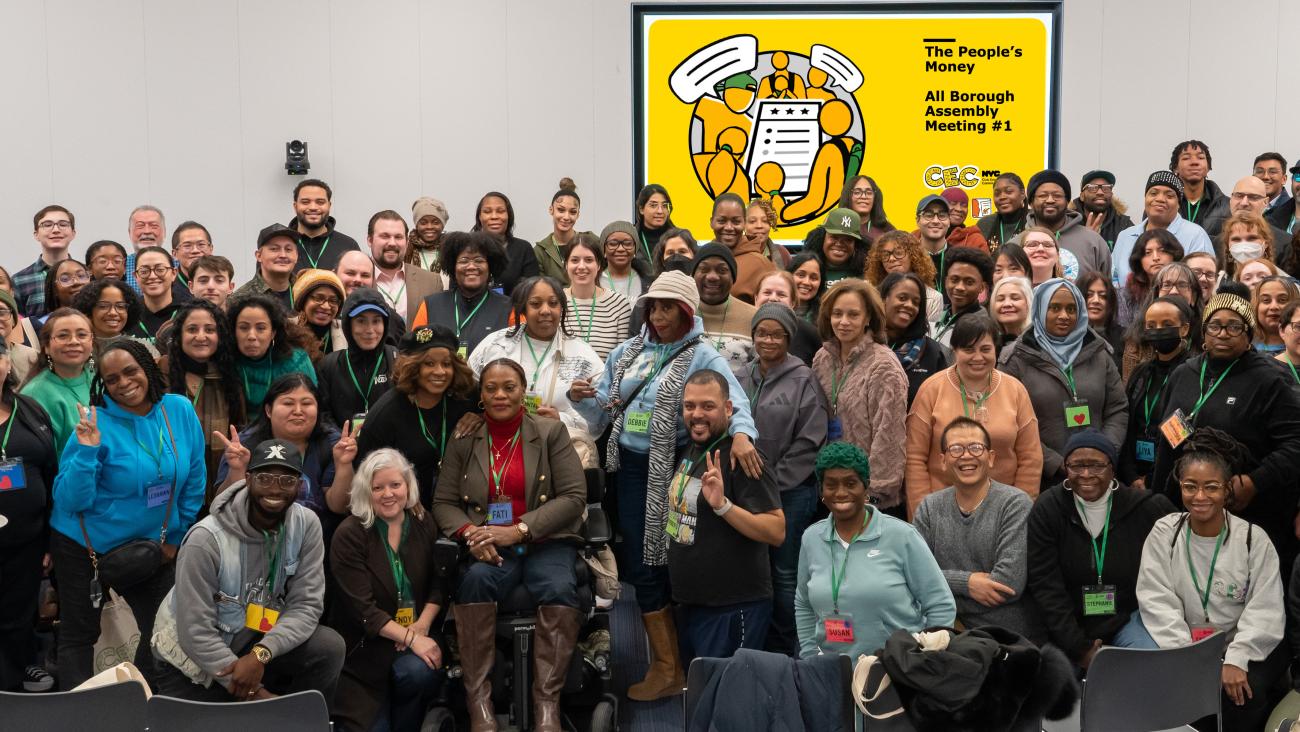
As trust in institutions falters nationwide, thousands of New Yorkers are taking decisions about public spending into their own hands.
Across the country, interest is growing in democratic innovations such as citizens’ assemblies, which convene representative groups of residents to develop solutions to complex policy challenges, and participatory budgeting, which gives communities direct input over portions of municipal spending. Despite growing interest in new approaches to democratic representation, few cities in the U.S. have adopted deliberative democracy at scale. New York City is a rare exception.
In 2022, the New York City Civic Engagement Commission (CEC) launched The People’s Money, an initiative that gives residents a direct say in how public funds are spent in their communities. Since then, the program has completed three funding cycles and directed more than $12.5 million to community programs and services across the five boroughs.
On May 6, proposals from residents opened for voting across the city as part of The People’s Money. Residents have until June 21 to vote on how the city should spend part of its budget.
Diversity and Debate
A key element of the process is the Borough Assemblies phase. After residents submit ideas to address local needs, the city convenes assemblies of randomly selected New Yorkers designed to reflect the demographic diversity of each borough.
These sessions generated more than 500 ideas for consideration by the borough-specific assemblies. More than 1,100 people applied to participate, and 25 residents from each borough were selected through a random process designed to ensure the assemblies reflected the communities they represented. Participants reviewed, discussed, and refined proposals before deciding which projects would advance to a borough-wide public vote.
As part of the Democracy Beyond Elections initiative — which aims to improve avenues for deliberative democratic practice across the city — Columbia World Projects partnered with the CEC and three Columbia Journalism School students in 2026 to profile assembly members from three boroughs, with the aim of understanding why they applied, how they navigated disagreement and collective decision-making, and what participation meant for their sense of civic agency.
Assembly Member Profiles
- The Bronx: Yeama Bangura and Dondi McKellar add
We all had the same interest and that interest was the Bronx, making the Bronx strong and keeping it strong.
Yeama Bangura, 25, and Dondi McKellar, 64, were two of the participants chosen for the Bronx borough assembly, which took place over four sessions in January and February.
Bangura was born and raised in the borough. “I've moved one block in my entire life,” she said. Even so, she didn’t develop deep connections with the community until recently. “My parents tried really hard for me not to interact with the Bronx when I was growing up,” she said. Bangura later got involved in activism and now runs wellness workshops for kids and works on producing a philosophy magazine on the side.
McKellar, on the other hand, is a U.S. Navy veteran, advocate with the Street Vendor Project and member of the LGBTQIA community. He was born in Lumberton, North Carolina, a “wonderful town,” he said, but “small” and “conservative.” He joined the Navy to get away and, in 1982, ended up in New York.
Not long after joining the Navy, McKellar said, he experienced a sexual assault. Because it occurred with a member of the same sex, he was dishonorably discharged. Years later, he tried to get VA benefits but was denied on that basis. After a long battle, he was able to win back pay. With that money, he decided to buy a house.
“Something inside of me said, go look in the Bronx,” he said. He moved to the borough in 2013. From there, his involvement in the borough snowballed. He joined the community board, playing an active role, and then the CEC Participatory Budgeting Advisory Committee Council until 2024. “I love the Bronx,” he said.
McKellar applied for all four iterations of The People’s Money. Last year, he was finally selected. “Over the moon, over the moon,” he said, when asked how it felt to be chosen to participate.
A Wide Range of Perspectives
The participants were split into groups, each assigned a different issue. Bangura and her groupmates focused on public safety, while McKellar and his groupmates looked at business development, parks, and youth. Over hours of discussion, each group reviewed the ideas before them and decided which should advance to the next stage.
"I loved our table,” said McKellar. “We came to the conclusion at the beginning that we can agree to disagree.”
Bangura said that despite group members coming from different backgrounds, she came to appreciate that a wide range of people cared about the same issues.
The experience also helped her feel closer to her community. “It made me feel more complete,” she said. “More well-rounded, more connected to the city.”
By the time the last session rolled around, Bangura said she would miss her fellow groupmates. “I'm honestly pretty sad,” she said. “I got close to the people in my group.”
After hours of talking, all the groups were able to reach a consensus and advanced 10 ideas for a vote.
“It was truly a group effort,” McKellar said. "We all had the same interest and that interest was the Bronx, making the Bronx strong and keeping it strong.”
How did he feel at the end of the four sessions?
“I felt like, wow, I earned this gift card,” he joked. “I felt a sense of accomplishment,” he added. “It was fulfilling.”
Bangura had a good experience as well, but she wishes they had the opportunity to advance more structural changes. The People’s Money project follows strict criteria for what it can fund, so some ideas were ineligible. For example, the proposals cannot involve construction, hiring permanent staff, or policy changes.
After residents vote, the winning programs will be implemented in the fall of 2026 and run for a year.
Participating in The People’s Money gave Bangura optimism for the future. “In a time especially where things feel so crazy, it feels good to have boots on the ground participation that is not simply a protest, but a bit of a more concentrated approach to creating change,” she said.
“We all want things to get better,” Bangura added. “It's just very nice to see that society isn't a lost cause.”
By: Julie Lee
- Manhattan: Erika Fowler add
I really feel like my voice was heard.
Ericka Fowler had served the City of New York for decades as a sergeant for the MTA Police. After her recent retirement, she faced an unfamiliar challenge: boredom and a search for purpose. That led her to The People’s Money, where she says she felt “at the heart” of the city again.
Fowler’s personal engagement with such programs began in her own neighborhood. There, she worked with fellow co-op owners to create a block association that would address their local concerns. She discovered the CEC and The People’s Money. What originally started as “looking for something to do” became “a revelation.”
Fowler was particularly surprised by the weight and attention given to her perspective. “I really feel like my voice was heard,” she says, before drawing contrasts to other programs and systems that “dismiss normal people.”
“It was so diverse,” she continued. “Diversity of people, of races, of jobs and of perspectives.” Fowler went on to say that she felt this granted the process even more power.
As the projects moved towards the final stages, Fowler said that she felt a sense of "physical proof" that her participation mattered.
Since the assembly ended, she has become a vocal advocate for The People’s Money. She often encourages friends and family to "latch onto" the process. Though she initially joined to fill her time, Fowler has found that in retirement, her most impactful work is in taking the chance to shape the budget priorities of local government.
By: Oliver Hall
- Brooklyn: Tyshawn Heath and Farheen Hasnat add
I really want to get inside the community, really understand people.
Tyshawn Heath, 22, of Bedford-Stuyvesant, and Farheen Hasnat, 46, of Brighton Beach, were among those selected to take part in Brooklyn’s borough assembly this year.
For Heath, a business student at Berkeley College who also works for Con Edison, the experience was formative.
“The CEC has changed my life,” he said. “It’s changed the way that I view things. It changed the way I communicate with other people and it also just changed the trajectory of my life.”
Heath said the structure of the sessions — where participants were encouraged to share perspectives, discuss neighborhood issues, and work toward consensus — pushed him out of his comfort zone.
“It really stuck with me because I was really shy,” he said. “And then it switched when I got to CEC and I’ve been really active in our community.”
Participants met over multiple sessions, spending hours reviewing proposals and discussing their potential impact. Divided into smaller groups, they were tasked with sorting through ideas, asking questions and deciding which ones were both feasible and meaningful enough to move forward.
Heath said he was struck by the range of perspectives in the room.
“I never thought that so many people had so many opinions,” he said.
The experience expanded his understanding of the challenges facing New Yorkers, he said, and of the role that residents can play in shaping solutions.
Since participating, Heath has become more involved in community work. He now volunteers with the Brooklyn Club of the National Association of Negro Business and Professional Women in Bedford-Stuyvesant, an organization he connected with through the CEC.
“I really want to get inside the community, really understand people,” he said.
That motivation, he said, has been with him from a young age.
“Helping people has always been the main thing for me,” he said. “I really hate seeing people struggle.”
During the assembly, those values shaped the proposals he supported. Drawing from his own experiences and those of his family, Heath said he paid particular attention to issues of safety, access, and opportunity.
He also backed educational initiatives aimed at older residents, including workshops to help seniors adapt to an increasingly digital world. As the world becomes more online, he said, older New Yorkers risk being left behind.
For younger residents, Heath pointed to economic uncertainty as a major concern.
“I haven’t met one person in college that wasn’t really stressed out about finding a job after school,” he said. “I really think that there has to be a bridge — there has to be a solution there.”
Finding Connections
Among the proposals discussed, one stood out to him: an initiative to create a national youth hub. He said he saw the proposal, which gained majority support from the assembly, as a way to connect young people to resources, mentorship, and pathways into the workforce.
For Heath, this experience left a lasting impression. He said it deepened his understanding of civic engagement and clarified the role he hopes to play moving forward.
Heath hopes to continue this journey to help fellow New Yorkers, and one day help people on an even larger scale.
For Hasnat, who spoke in Urdu through a translator, the path to the borough assembly began with a message in a WhatsApp group chat.
Born in Pakistan, she has lived in Brooklyn for 25 years and now resides in Brighton Beach. A mother of three, Hasnat spends much of her time caring for her family while also working part-time as a henna artist.
Hasnat said she decided to apply after persistent issues with rats on her block.
Although that issue did not ultimately make it onto the ballot, Hasnat said participating in the process still felt worthwhile.
“I’m happy somebody gets help,” she said.
A Unified Goal
The sessions brought together residents from different backgrounds and even when participants had different priorities, Hasnat said, the goal remained the same: improving their communities.
Outside of the assembly, Hasnat remains engaged in civic life. She has worked at poll sites for the past four years and stays connected to community organizations, including APNA Community Services.
For Heath and Hasnat, the borough assembly offered a chance to engage directly with how decisions are made in the city, and to better understand the perspectives of other Brooklynites.
Over the course of the sessions, participants worked through differences and ultimately agreed on a set of proposals to advance.
Like other participants, Hasnat spent hours reviewing proposals and discussing their potential impact with fellow assembly members. Over time, Hasnat said, the group became one of the most meaningful parts of the experience.
“It felt like a big family,” she said.